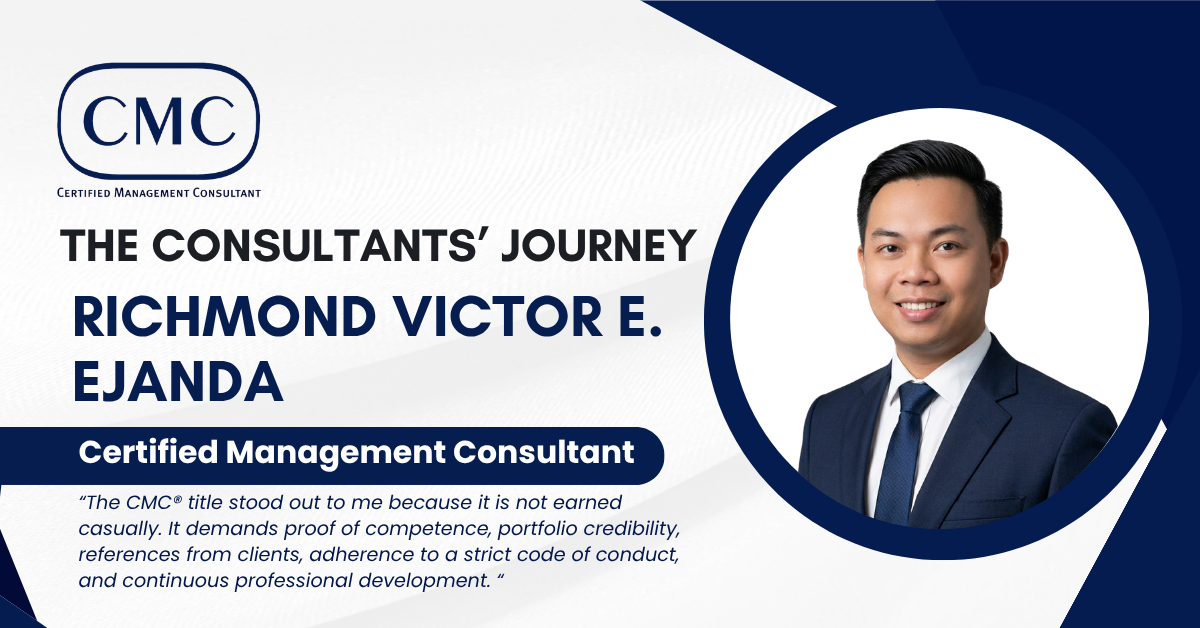
Richmond Victor E. Ejanda, CMC®, is a multidisciplinary Lead Corporate Consulting R&D Scientist-Technologist whose professional practice integrates deep technical expertise with strategic management consulting. His work spans food and beverage manufacturing, regulatory affairs, quality systems, and strategic innovation, where he applies a systems-thinking approach to help organizations achieve operational maturity and sustainable growth.
CMC® Certification Story
Motivation for pursuing the CMC® designation
“My decision to pursue the CMC® designation was driven by a maturing responsibility. I had already been consulting for years, building systems for food and beverage companies, formulating products, guiding FDA registrations, and designing operational frameworks for MSMEs. But the more projects I handled, the clearer it became that expertise alone is not sufficient. Consulting carries influence. Influence carries accountability. I wanted my work to be anchored not just in experience, but in recognized global standards of ethics, methodology, and professional rigor.
The CMC® title stood out to me because it is not earned casually. It demands proof of competence, portfolio credibility, references from clients, adherence to a strict code of conduct, and continuous professional development. It aligned with how I see consulting: a profession defined by measurable impact, disciplined frameworks, and commitment to quality. There was also a personal dimension. I wanted to benchmark myself. Not against others, but against the highest standards of practice. I wanted to validate that the work I built over the years, manuals, R&D pipelines, compliance programs, and organizational reforms was not only effective in execution but strong enough to meet global consulting expectations. Earning the CMC became a form of internal audit. It forced me to reflect on my methodology, refine weaknesses, strengthen documentation discipline, and articulate the structure behind how I solve problems.
The motivation deepened further when I realized how few technical consultants in the Philippines bridge manufacturing, regulatory compliance, R&D, and organizational systems into one practice. I wanted to help raise the ceiling. Elevate the consulting landscape. Be part of the professionals who lead transformation, not just transactions. Pursuing the CMC® was my way of committing to excellence without shortcuts. It meant holding myself to a standard even when no one is watching. It meant consulting with ethics, evidence, and accountability. It meant ensuring that every report, audit, project, and strategic decision I contribute to carries integrity and technical soundness. For me, the CMC® title is not just a credential. It is a responsibility; to represent what consulting should look like. To build organizations with clarity and long-term capability. To leave every client better than before engagement. And to continue evolving as a professional committed to mastery and impact.”
Preparation approach and most challenging part
“The CMC® process tested more than my consulting experience. It tested structure, discipline, and the ability to articulate years of work into verifiable documentation. One of the earliest challenges was compiling proof of consulting engagements. Projects I completed over the years were diverse; regulatory compliance, R&D development, QMS building, process optimization, but translating them into structured case documentation required time and deep recollection. Consulting work often moves fast. You solve problems and transition to the next. The application forced me to pause and reconstruct each engagement: scope, methodology, deliverables, client outcomes, and evidence. Another challenge was summarizing transformation outcomes in measurable form. It is easy to say “improved quality system,” but the panel requires detail. What indicators changed? How was efficiency increased? What compliance risk was reduced? I reviewed old reports, audit results, version histories of SOPs, FDA approvals, formulation files, even email trails of decision-making. It reminded me that consulting impact must be recorded, not just remembered. Documentation protects value. The most demanding part was the self-reflective component. You must articulate not only what you achieved but how you think. What frameworks you used. How you handled conflict. What ethical dilemmas you navigated. It required honesty. I acknowledged situations where communication was challenging, where systems faced resistance, where implementation needed iteration. Overcoming this meant revisiting my learning curves with maturity instead of ego. Time management also tested me. While processing requirements, I continued serving clients, conducting audits, developing formulations, and running operations. I dedicated fixed hours weekly to work on my portfolio. I treated it like a project with milestones; document gathering, write-ups, reference validation, review, formatting, and final assembly. Structure became my solution to time constraints. Mentorship and collaboration also helped me advance. Conversations with colleagues who completed their CMC reminded me that the process is achievable with discipline. Their guidance helped me understand expectations, align documentation quality, and avoid common submission gaps. What helped me overcome the challenges was simple, consistency over intensity. I built the portfolio one document at a time, one proof at a time. Eventually, the files formed a coherent professional narrative. The challenges were necessary. They made the certification meaningful. They reaffirmed that consulting is not defined by titles but by ethical practice, technical depth, and evidence of impact.”
Benefits gained personally and professionally
“The most valuable insight I gained through the CMC® process is that consulting is not merely about solving problems; it is about building systems that prevent them. Before the certification, I delivered solutions. After the journey, I became more conscious about designing long-term capability frameworks rather than short-term fixes. The CMC® process made me examine how I think, how I decide, and how I scale solutions beyond myself.
The journey strengthened my belief that clarity is a consultant’s power. When thinking is clear, communication becomes simple. When communication is simple, execution becomes consistent. This insight elevated not only how I write reports, manuals, and quality documentation but also how I guide decision-makers in boardrooms and operators on the factory floor. I learned to remove noise and present direction in clean lines.
I also grew in the area of ethical decision-making. The CMC® code of conduct reminded me that consulting is a position of influence. Companies trust you with information, vulnerabilities, and strategic decisions. That trust is earned through discretion, honesty, and the ability to tell clients what they need to hear, not always what they want. Professional integrity is not negotiable. Another growth area was self-awareness. The application forced me to look at my work objectively. Which methods consistently worked? Where could I improve? Which solutions were too complex for small teams, and how could they be simplified? Reflection sharpened my consulting style. It made me more deliberate, more structured, and more conscious about measuring outcomes.
The CMC® journey taught me to value documentation as legacy. Reports, SOPs, manuals, training modules, these become institutional memory that outlasts engagement. The mindset shifted from “finish the project” to “institutionalize knowledge.” The best consultant is not the one clients keep forever. It is the one who builds them strong enough to stand independently. Overall, the certification did not change who I was. It clarified who I have become. It aligned my practice with global standards, validated years of experience, and strengthened my confidence to take on more complex engagements with discipline and depth.”
How the CMC® credential enhances credibility and opportunities
“The next decade of my consulting career will focus on scale, institutional impact, and knowledge transfer. My foundation years were spent building capability inside manufacturing companies; improving systems, developing products, writing documentation, and guiding regulatory pathways. The next chapter is about multiplying that impact across more organizations, more industries, and more future professionals.
I intend to evolve from a purely hands-on consultant into a builder of frameworks, curricula, and scalable systems that companies can adopt independently. This includes developing standardized SOP/QMS toolkits, training modules, regulatory navigation guides, and AI-assisted R&D systems tailored for MSMEs, nutraceutical manufacturers, food processors, and emerging brands in Southeast Asia. The goal is to democratize capability and make professional manufacturing standards accessible even to smaller players. I also see myself expanding into innovation strategy consulting, helping companies move beyond traditional products toward functional, sustainable, and science-forward formulations. With global health trends rising, the Philippines has the potential to become a strong player in nutraceutical manufacturing. I want to help build that movement.
Part of my long-term roadmap is establishing a research-driven formulation and compliance laboratory, serving as a bridge between science and commercialization. A space where ideas become prototypes. Prototypes become validated products. And validated products become regulated market-ready SKUs. I would also like to write more books, scientific articles, playbooks for practitioners, and frameworks that outlive my physical presence. Knowledge that becomes reference material for future food scientists, consultants, and quality leaders. Teaching is part of my future. Whether through formal modules, industry workshops, or international collaborations, I want to help shape the next generation of professionals with the discipline of quality and the courage for innovation. Ten years from now, I envision my consulting identity not only defined by the number of companies I helped, but by the number of systems that kept running, long after I stepped out. Sustainability of impact. That is the career I am building.”
Message to consultants considering CMC® certification
“Start with mastery, not titles. Consulting is not something you declare. It is something you earn through work that delivers results. Build depth in your field until solving problems becomes instinctive. Learn the science behind decisions, the systems behind operations, and the people behind execution. Knowledge is only powerful when applied.
Document everything. Keep case records, drafts, reports, lessons, failures, improvements. Your portfolio will be built not in one year but across many. The credibility you carry later will come from the work you preserved today. A consultant’s value multiplies when evidence of impact is traceable. Learn to communicate clearly. Complex problems require simple instructions. If you can explain a process to the production helper and also defend it to the board, you’re on the right track. Influence grows through clarity. Trust grows through consistency. Respect grows through professionalism. Be ethical even when no one is watching. You will face situations where shortcut solutions seem convenient. Resist the temptation. Choose compliance over speed. Choose safety over convenience. Choose long-term trust over short-term approval. Integrity is a consultant’s currency. Once lost, it does not return easily.
Invest in continuous growth. Read. Study. Work with mentors. Attend audits. Volunteer in projects bigger than your comfort level. Expose yourself to structured work, not just busy work. The market rewards problem solvers who think, not just do. Most importantly, build your consulting identity around service. The goal is not to look intelligent. The goal is to elevate organizations. The best consultants leave behind systems, not dependence. They create capability in others. They make themselves less needed as the company becomes more competent. If you walk this path with discipline, curiosity, integrity, and the willingness to do the hard work no one sees, consulting will not just become a career. It will become your contribution to the industry.”